

The Sweet and Lowdown
Season 10, #4: Nightwalking composes a solitary tune and bids 2025 goodbye

“Savage was at the same time so touched with the discovery of his real mother that it was his frequent practice to walk in the dark evenings for several hours before her door, in hopes of seeing her as she might come by accident to the window or cross her apartment with a candle in her hand.
But all his assiduity and tenderness were without effect, for he could neither soften her heart nor open her hand, and was reduced to the utmost miseries of want while he was endeavoring to awaken the affection of a mother. He was therefore obliged to seek some other means of support; and, having no profession, became by necessity an author…”
—Samuel Johnson, “The Sufferings of Savage,” from Lives of the English Poets
THERE IT IS—THE precise moment when hope and expectation meet “the utmost miseries” during the “frequent practice [of walking] in the dark evenings for several hours.”
Ah, well I remember it.
And even though the late, great Mr. Richard Savage’s nocturnal prowlings were a solid three hundred years ago, it still screams “Nightwalking!” to me today.
Nightwalking is a form of dedication—almost like moving your feet toward an altar made of night air, kneeling like a supplicant before God-knows-freakin’-what, and moving your lips to the music of prayer.
If that sounds a bit airy-fairy, ookie-pookie pudding ‘n’ pie … well, so be it.
It’s been a good Nightwalking season this year: best in late summer when there are crickets chirping or frogs croaking, or autumn just before “all the leaves are gone, and the sky is gray.”1 Which of course reminds me (and always will) that music, because it’s largely from the heart, ties in deeply with Nightwalking. My ol’ nocturnal stumblefoot ain’t at its best when it comes to coughing up the right words. But it’ll whistle a tune or hum an old hymn and just keep walking on.
When I reread Samuel Johnson’s take on his friend Richard Savage’s early life, it’s heartbreaking—with a dash of sweetness and the gut-punch of a lowdown after-burn. My own “Nightwalking heart” wants to make sense of his abandonment by and longing for his mother. If only he had someone with whom he could talk it over!
Then Stargazing kicks in (definitely a form of imagination) and muses: “What if Richard Savage suddenly turned into a bright-winged moth and banged at his mother’s window? Would she see him then? Might she open the window, allowing him to fly to her, fluttering about her head, possibly delighting her and himself and breaking the leaden isolation of his night walk?”
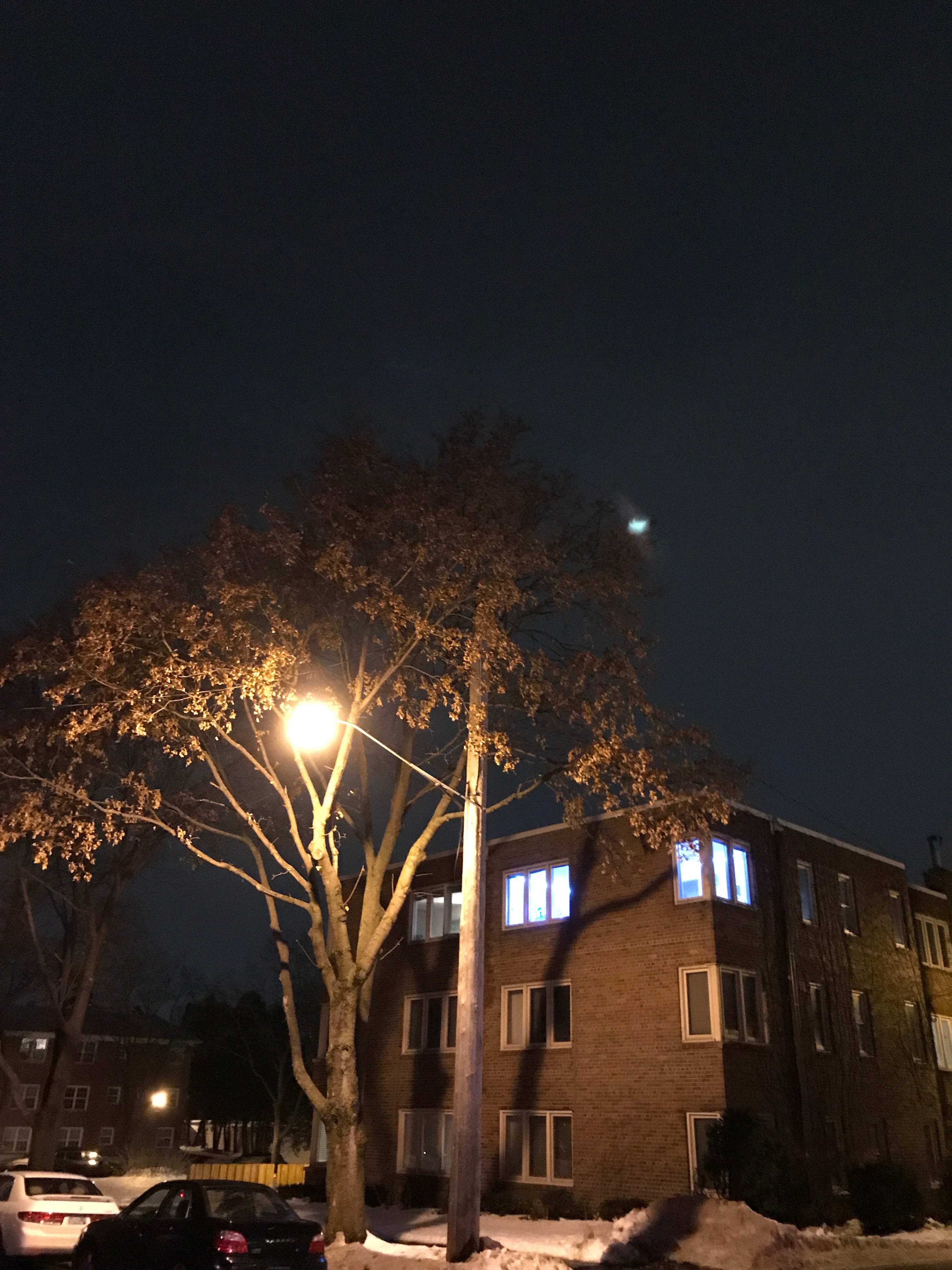
But we mustn’t forget the candle in her hand, right? He now being a moth—well, you do the math.
Fast-forward into the twentieth century—1978 to be exact—and a Nightwalking songwriter by the name of Justin Hayward sings a tune originally penned by Jeff Wayne, Gary Osborne, and Paul Vigrass titled “Forever Autumn.”2
That year I was leaving high school and in two years’ time forever saying goodbye to my Nightwalking jaunts of the ’70s: Casco Point’s “Circle,” on Lake Minnetonka. That song would’ve definitely been looping through my head.
And I adored it.

BEFORE HE DIED IN 1862 at the age of 45 of tuberculosis, Henry David Thoreau kept his pen firmly in hand. In his essay “Night and Moonlight,” he gives voice to mute Nightwalking: “Many men walk by day,” he writes, “[but] few walk by night. It is a very different season.”3
He goes on to acknowledge a sort of “consciousness” behind Nightwalking [emphasis mine]:
The woods are heavy and dark. Nature slumbers. You see the moonlight reflected from particular stumps in the recesses of the forest, as if she selected what to shine on.
Thoreau’s attention to detail might seem trivial to the early 21st century distracted mind, but perhaps that’s leaning away from Nightwalking’s beating heart and closer to our overtired and overthinking heads. Even a century and more later, he seems to agree:
How insupportable would be the days, if the night with its dews and darkness did not come to restore the drooping world. As the shades begin to gather around us, our primeval instincts are aroused, and we steal forth from our lairs, like the inhabitants of the jungle, in search of those silent and brooding thoughts which are the natural prey of the intellect…
If Nightwalking could talk, or if it had a companion through the gloom—all its dews and darkness—maybe it would finally spill its overflowing yet secret heart.
In Nightwalking musical terms, I’m reminded of Gayle Caldwell’s 1968 song, “Cycles,” which I first discovered through Rickie Lee Jones’ 2000 album It’s Like This and then later, to my surprise, Frank Sinatra’s version.4
Caldwell’s original (and to my mind, Sinatra’s too) is somewhat jaunty, but Rickie Lee Jones nails the tone both lyrically and musically throughout, including a tinge of wryness from what I think is a stand-up bass.
But you might be wondering, how is “Cycles” like Nightwalking?
Well, it’s as close as I can imagine to articulating two opposing thoughts (and their resonating emotions) at the same time: Things are bad, but hey, they’ve been that way before and there’s no reason to think—like the seasonal cycles, even the rising and setting of the sun—that they won’t at some point become better again.
In the end, I’d say that’s a good use of one’s melancholic reflections.
And also Prime Time Nightwalking.

Exciting StoryShed Subscriber News
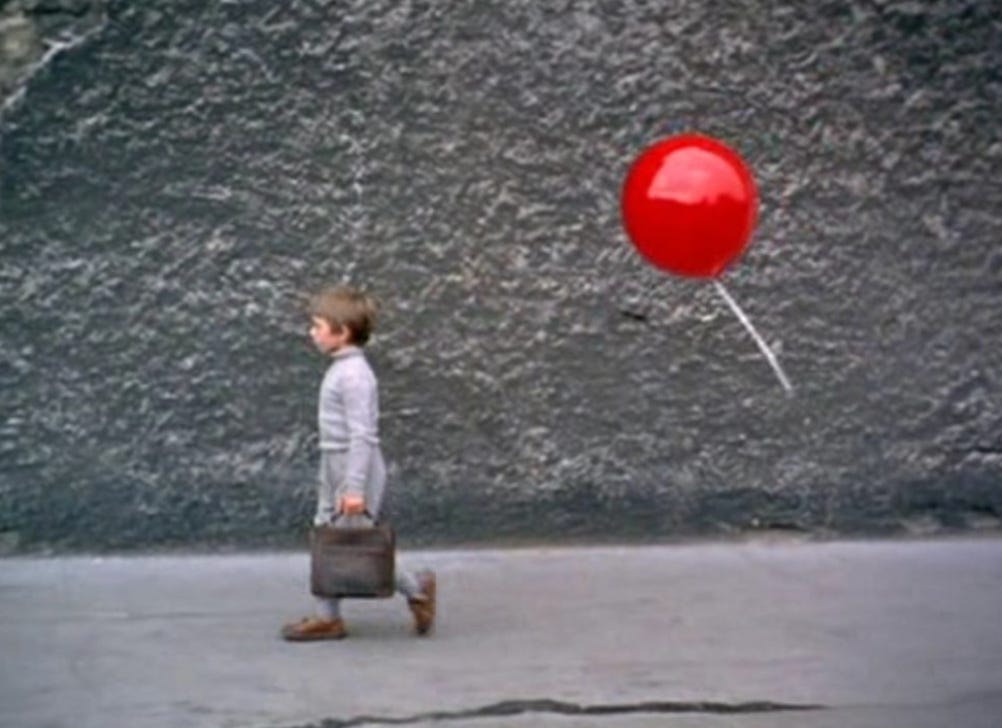
StoryShed has started a new seasonal tradition…watching Albert Lamorisse’s classic film The Red Balloon (1956) every November going forward. Why? It’s probably one of the first movies I ever saw (likely in elementary or kindergarten, even when they’d show European films to kids that might have disturbing overtones) and its message (actually, is there really one outside of being open to all the world has to offer?) is perennial—timeless, even.
Have you ever seen The Red Balloon?
What did you think?
Leave your comments below!
It’s been a fantastic year for StoryShed Media here on Substack.
Highlights include: The Ingmar Bergman Winter Survival Series from earlier in 2025, and the long-form essay (covering the entire Season 8 episodes) America Is a Haunted Place, with my impressions of the Minneapolis Institute of Art’s Supernatural America exhibition from 2022. Plus all the regular essays on Daytalking, Nightwalking, and Stargazing, and all the ones planned for 2026!
Coming up for Season 11: Stargazing (in January 2026) each episode of the season will pose a different question and mull it over or seek solutions. You won’t want to miss it.
After analyzing posts and full-length essays from the past year, I’ve decided (at least compared with most other ‘stacker friends) I’M NOT PUBLISHING ENOUGH! To that end, I won’t be publishing every day (unless you’re a news organization on Substack, or a ‘stacker with a vast quantity of content to publish—which is possible—but it doesn’t make much sense for my work), but I will be keeping the seasons at four episodes per season, and ADDING a weekly digest starting next week (end of the week of Dec. 8, publishing first thing Saturday mornings, 9 a.m. CST, so 12/13/25 will be the debut issue).
What is this digest? I’m thinking short and sweet—a sort of StoryShed “Mini-Me” with a working title of The Shack or StoryShedding. The hope is the digest will connect more with StoryShed’s free and paid subscribers and get word out about all the good work other creators are doing on Substack.
Hopefully a win-win for readers and fellow writers.
SPEAKING OF WHICH you can now upgrade to a paid subscription (yearly is your best value!) with this link…
If money is tight (and I mean, who can’t say that?) I would really appreciate a recommend or restack to keep StoryShed’s line-of-sight with the algo.
Thank you for subscribing or following, and happy holidays—however you choose to celebrate them!

Notes and extra texture
Grateful for Listen to the Land’s Jo Petroni for her marvelous illustrations, as usual.
The Mamas and the Papas, “California Dreamin’” (1965)
Justin Hayward sings “Forever Autumn” (1978)
Thoreau, Henry David. “Night and Moonlight” from Excursions, Houghton Mifflin Co., 1891.
Gayle Caldwell, songwriter of “Cycles” (1968) with cover versions by Rickie Lee Jones (2000) and Frank Sinatra (1968).
I always enjoy your writing,Michael. Thanks for including the videos because I wanted to hear them. "Forever Autumn" and "California Dreamin'" are fantastic songs and agree that they capture that certain feeling.