

Tree by Bryant
Season 11, #4: Did J.R.R. Tolkien prove there's an afterlife? And does it matter if he didn't?

IT’S ONE THING TO lose an old friend—whether to politics or religion (or both), or a combination of factors such as career or family relocation and, well, just plain growing apart. It’s another thing altogether to lose a new friend to … death.
That happened to me last December.
I first discovered writer Richard Bryant from his LinkedIn posts where I learned about his Substack “Elevate the Discourse” (see link below in “Extra texture”). Richard became a supporter and subscriber to StoryShed and we probably had a handful of convos over the course of 2024–25. In November 2025 we’d planned on collaborating on a long-form post: a course I wanted to teach prior to the pandemic on death and dying (I’d planned its curriculum a couple years after my parents died in 2008).
Richard and I last spoke on a Zoom call that November—specifically about the How2Die course and what that might look like rolled out on Substack. He suggested a sort of correspondence—like C.S. Lewis’ The Screwtape Letters—on what “How2Die” might mean if stretched out over many posts. I thought that was a fine idea, but we didn’t set a deliverable date on the first letter—or even who would author it—and that’s when I learned from his wife Mary that Richard had suddenly passed away.


I was heartbroken for Richard’s family and friends in North Carolina, and wished I had the resources to make it to his memorial service.
Not having a friend at this point in life (I’m in my mid-60s and Richard was only 51) is particularly discomforting…I lost so many old friends to the pandemic and ongoing political situation in the U.S., and it’s been isolating and frightening.
—And to be honest, as I was writing this, I fell into despair.
2
The first living being I ever watched die was our family dog, a Cocker Spaniel named Taffy. Mom and Dad got her from my great uncle Horace Magee, a retired postmaster who raised show dogs in Mom’s hometown of New Castle, Indiana.
Of course you probably want to see Taffy, don’t you?
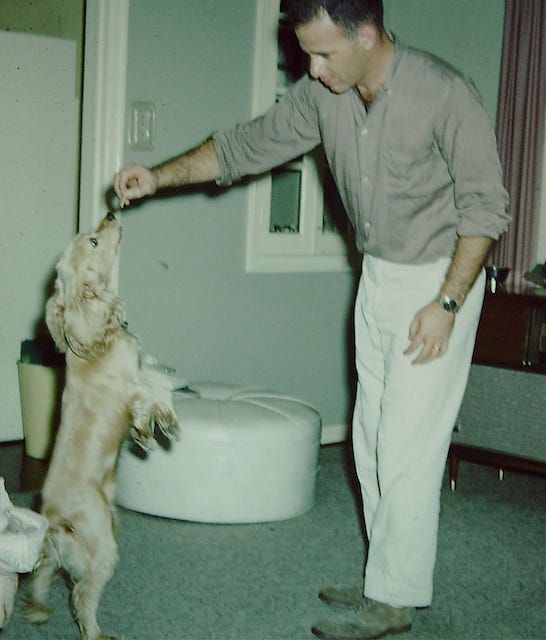
She was a good dog and we loved her of course, since she always herded me and my brother away from the street when we were children. She was soft and friendly and I don’t particularly recall her barking much.
We lost Taffy when we were then living just outside Olney, Maryland, renting a house wedged between a cow pasture and a horse field. Taffy died just inside the huge garage that was stuffed with storage items left by a previous renter. I remember petting her as she lay in the dust beside the garage door, and finally watching her snort out a last breath.
—Just like that, gone. Not there anymore. Only her body.
Dad buried her beside the old playhouse next to an apple tree. And then promptly went out and found a Sheltie puppy my brother named “Lassie.”
So it goes. One in, one out.
3
Now I’m feeling fucking angry. Why? Because of doubt.
I so wanted to avoid pull quotes for this essay. And I didn’t know what I was going to say or do in the wake of Richard’s passing. We never got to write that correspondence and put it up on Substack. I never got to work with him on refining How2Die, which in the end would try to prove Socrates’ assertion there is “life after death.”
Richard agreed that it was true—Socrates did prove something of the sort. But then my friend shuffled off this mortal coil. Like Socrates.
I thought of a story by J.R.R. Tolkien titled “Leaf by Niggle,” which I re-read, then sought out Humphrey Carpenter’s acclaimed biography of the Middle Earth author. I knew “Leaf by Niggle” was something of an allegory—a type of tale Tolkien abhorred to his bones. But I didn’t know about his affinity for trees.
“And though he liked drawing trees [Tolkien] liked most of all to be with trees,” Carpenter writes in his biography:
He would climb them, lean against them, even talk to them. It saddened him to discover that not everyone shared his feelings towards them. One incident in particular remained in his memory: ‘There was a willow hanging over a mill-pool and I learned to climb it. It belonged to a butcher on the Stratford Road, I think. One day they cut it down. They didn’t do anything with it: the log just lay there. I never forgot that.’1
Suddenly I wanted to know if Richard Bryant felt the same way about trees. I decided since this is the last essay on Stargazing, and ahead of a new season of Daytalking, that I’d reach out to Mary to find out where her husband stood on the topic of trees and Tolkien. I’ll report back if I hear from her.
And I didn’t know that J.R.R. Tolkien was an accomplished painter and artist. Writes Carpenter: “He was at his best when picturing his beloved trees, and like Arthur Rackham (whose work he admired) he could give to twisted root and branch a sinister mobility that was at the same time entirely true to nature.”2
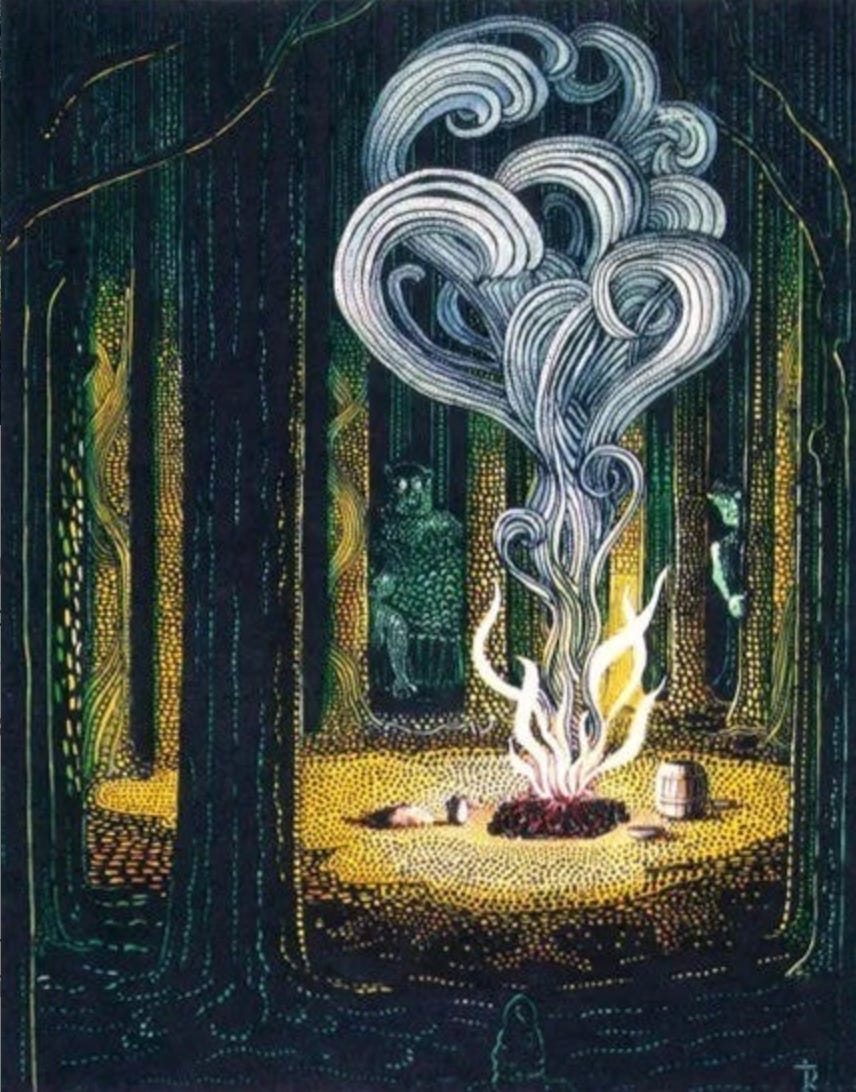
But why do I think “Leaf by Niggle” is anything like the How2Die course, or anything remotely like the Socratic method Richard and I hoped to explore?
I don’t. But it paints a compelling picture of what post-human “reality” might involve. I discovered Tolkien’s story has five somewhat distinct sections, the first of which begins: “There was once a little man called Niggle, who had a long journey to make. He did not want to go, indeed the whole idea was distasteful to him; but he could not get out of it” and plainly tells us, “He was the sort of painter who can paint leaves better than trees.”3
In every respect Tolkien’s short story starts out as a classical fairy tale, down to the “There once was…” or “Once upon a time…” trope.
And of course the “long journey” Niggle doesn’t want to make is the same for us all: the end of our lives and what lies beyond.
4
‘What really happens,’ Tolkien wrote, ‘is that the story-maker proves a successful ‘sub-creator.’ He makes a Secondary World which your mind can enter. Inside it, what he relates is ‘true;’ it accords with the laws of that world. You therefore believe it, while you are, as it were, inside. The moment disbelief arises, the spell is broken; the magic, or rather art, has failed. You are then out in the Primary World again, looking at the little abortive Secondary World from the outside.4
Of course, we all dream at night.
You awaken in the morning and think, “That was an odd dream,” because the spell of dreaming has been broken. But what if life were the seemingly unbroken spell and death was just another awakening? What might that mean?
This is Tolkien’s notion of sub-creation and the writer (or artist, painter, what have you) is the sub-creator. Our lives are merely sub-creations of our own making: family, friends, lovers and colleagues are characters coming and going from these creations. Perhaps the conscious world is trying to imprint their sub-creations on your sub-creation—confusing, I know, but keep in mind what is beyond sub-creation, in some Ur-universe, perhaps a place closer to “reality” than you or I might realize.
The world—that insistent reality we awaken to every day—says to you, as it did to Niggle: “‘There has been a flood in the valley, and many families are homeless. You should have helped your neighbor to make temporary repairs and prevent the damage from getting more costly to mend than necessary. That is the law. There is plenty of material here: canvas, wood, waterproof paint.’”5
That material was Niggle’s painting—a vast tree, each leaf of which he painstakingly worked on for years, and yet “That is the law” is immaterial when you’re talking about multiple levels of existence, right?
There is something beyond that, as Carpenter points out: “…in [Tolkien’s] essay ‘On Fairy-Stories’ and in his story ‘Leaf by Niggle,’ both of which suggest that a man may be given by God the gift of recording ‘a sudden glimpse of the underlying reality or truth.’”6
I believe Tolkien instinctively knew that, probably from an early age.
But how does he prove there’s consciousness—life!—after death? And how “sudden” is that glimpse into an underlying reality?
5
“So far I have felt all the normal feelings of a man my age,” Tolkien wrote after learning of his friend C.S. Lewis’s death in 1963, “like an old tree that is losing its leaves one by one: this feels like an axe-blow near the roots.”7
This is my experience going into my mid-60s—and yet I have no way of knowing what Richard was going through before he passed away last December.
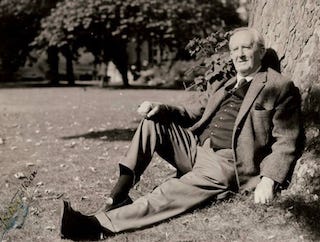
Tolkien writes in his story: “Niggle was lying in the dark, resting completely; so that, as he had not been either feeling or thinking at all, he might have been lying there for hours or for years, as far as he could tell.”8
What is consciousness? What is unconsciousness?
What is life—or for that matter, death?
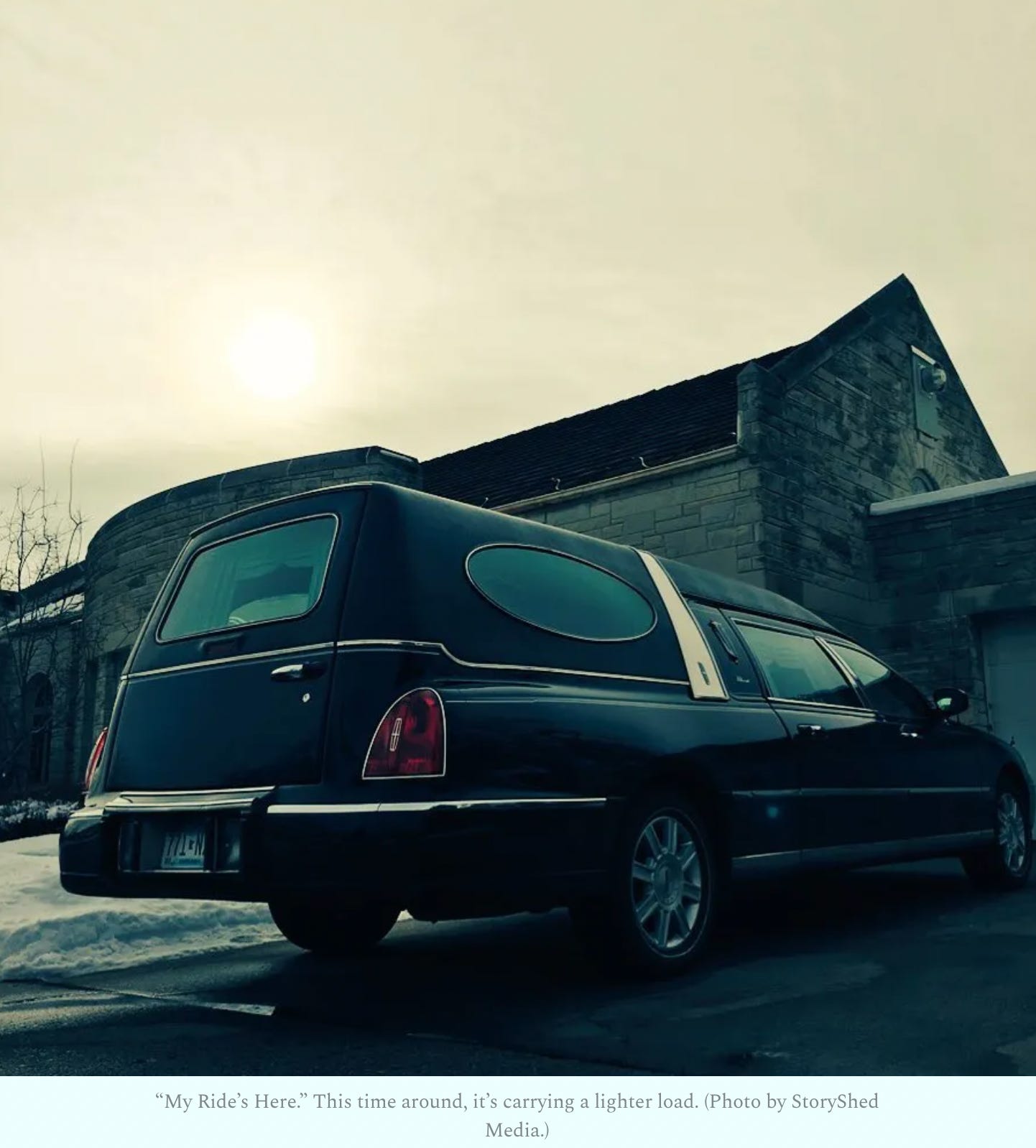
“The carriage was ordered long ago. It has come at last. It’s waiting. You start today on your journey, you know.”9
I’ve no patience for people in their one groove—those who’ve found their track and they’re staying put. I realize this makes me harder to define, but what of that? Do you judge a tree by its trunk or by its leaves? Is it dead or alive or somewhere in between?
I think Richard had an amazing life: family, a life partner, and a life’s work he could really be proud of. While over ten years my junior, that makes me feel I need to step up and do better for myself. Maybe in this case he’s Niggle and I’m his neighbor Mr. Parish, who comes on after him to the place with the marvelous Tree: Niggle’s Parish? Or Tree by Bryant? I think he’d like that.
Because, when it happens, there’ll be no preface or early warning.
When you go—man, you’re gone.
6
Before him stood the Tree, his Tree, finished. If you could say that of a Tree that was alive, its leaves opening, its branches growing and bending in the wind that Niggle had so often felt or guessed, and had so often failed to catch. He gazed at the Tree, and slowly he lifted his arms and opened them wide. ‘It’s gift!’ he said. He was referring to his art, and also to the result; but he was using the word quite literally.10
The crazy thing about Tolkien’s story is how it ends: back in “reality,” which is odd because the final vision, quoted above, is sublime on its own. But two workers “on Earth” are grumbling about Niggle and Mr. Parish and they have a prescription for anyone who would follow them:
‘But you don’t, and so we get useless people of his sort. If I ran this country I should put him and his like to some job that they’re fit for, washing dishes in a communal kitchen or something, and I should see that they did it properly. Or I would put them away. I should have put him away long ago. …Push him through the tunnel into the great Rubbish Heap: that’s what I mean.’11
If you think you’ll be remembered after death, good luck with that. The memory decay happens quickly, and to lasting effect:
That was probably the last time Niggle’s name ever came up in conversation. However, Atkins preserved the odd corner. Most of it crumbled; but one beautiful leaf remained intact. Atkins had it framed. Later he left it to the Town Museum, and for a long while ‘Leaf: by Niggle’ hung there in a recess, and was noticed by a few eyes. But eventually the Museum was burnt down, and the leaf, and Niggle, were entirely forgotten in his old country.12
During our last Zoom chat, Richard mentioned a possible title for our project, “An Oral History of Life After Death” and I think he quoted something from First Corinthians 15.
Instead, I offer this poem:
Though myriads go with him who goes,
Alone he goes where no wind blows,
Unto the land which no one knows.
***
For all must go where no wind blows,
And none can go for him who goes;
None, none return whence no one knows.
—Ebenezer Elliott (1781–1849)

Footnotes and extra texture
I bumped into a Tolkien letter 98 (18 March 1945) to publisher Stanley Unwin. Tolkien talks about how he came to write “Leaf by Niggle”:
…that story was the only thing I have ever done which cost me absolutely no pains at all. Usually I compose only with great difficulty and endless rewriting. I woke up one day (more the 2 years ago) with that odd thing virtually complete in my head. It took only a few hours to get down, and then copy out.
A last thought from Richard:
“Dying alone is not simply a matter of having people around us when the end comes. It is about living a life rich in connection and purpose, where solitude and companionship are not at odds but are two sides of the same coin.”
Rich would’ve enjoyed the humor here, too:
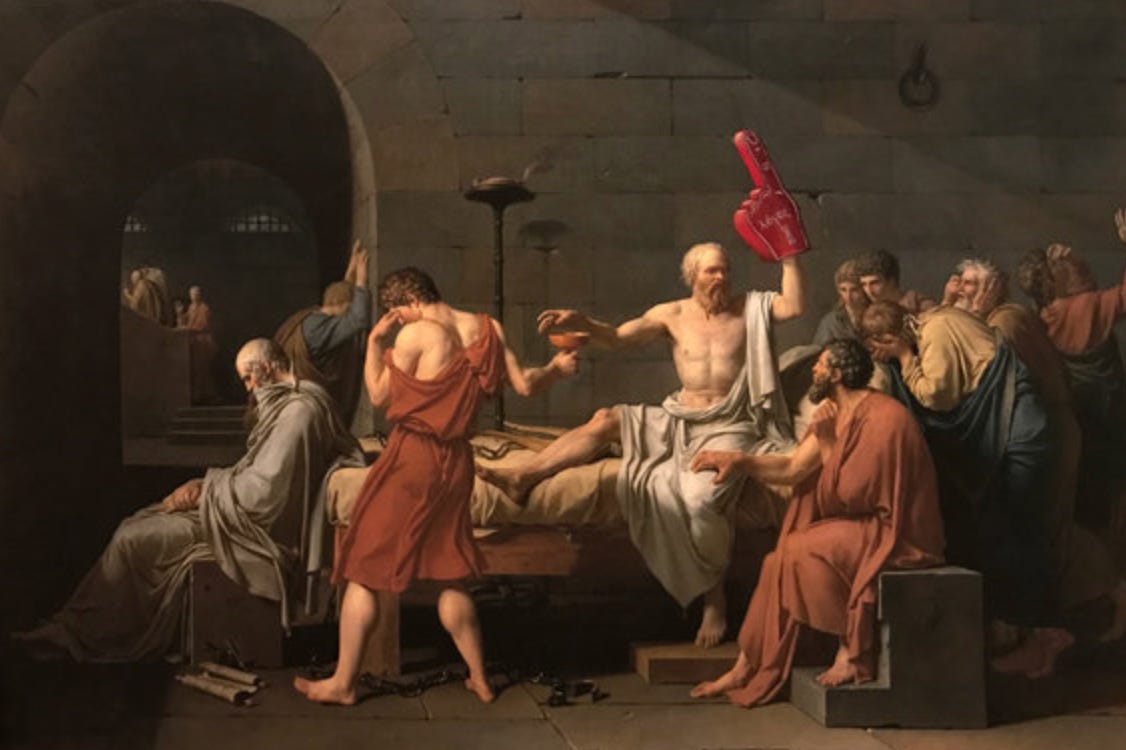
And here’s why:


J.R.R. Tolkien: A Biography by Humphrey Carpenter, William Morrow Co., 2000, p.30
Ibid., pp. 166–167.
“Leaf By Niggle” by J.R.R. Tolkien, from Fantastic Worlds: Myths, Tales, and Stories, edited by Eric S. Rabkin, Oxford University Press, 1979. p. 144.
J.R.R. Tolkien: A Biography by Humphrey Carpenter, William Morrow Co., 2000, p.194–195.
“Leaf By Niggle” by J.R.R. Tolkien, from Fantastic Worlds: Myths, Tales, and Stories, edited by Eric S. Rabkin, Oxford University Press, 1979. p. 146.
J.R.R. Tolkien: A Biography by Humphrey Carpenter, William Morrow Co., 2000, p. 99–100.
Ibid., p. 243. (Tolkien on the death of his friend C.S. Lewis.)
“Leaf By Niggle” by J.R.R. Tolkien, from Fantastic Worlds: Myths, Tales, and Stories, edited by Eric S. Rabkin, Oxford University Press, 1979. p. 149.
Ibid., p. 147.
Ibid., pp. 152–153.
Ibid., p. 157.
Ibid., p. 158.
Thank you for writing this. Richard and I had a lot of banter. I miss him.
Powerful piece, Mike. I’m so sorry for the loss of your friend.