The OG Nightwalking
Season 13, #1: It's part of a triad I discovered in 2011, two years after my parents died

HERE ON SUBSTACK, ONE of the first posts about Nightwalking (especially in the summertime) was from nearly four years ago ICYMI:
Summer of Nightwalking

“I dine, I play a game of back-gammon, I converse, and am merry with my friends; and when, after three or four hour’s amusement, I would return to these speculations, they appear so cold, and strain’d, and ridiculous, that I cannot find it in my heart to enter into them any farther.”
But the real origin story of “Nightwalking” comes from my WordPress blog Completely in the Dark, which pulled the term from a diary entry when I wrote the post in August 2011. So, it’s been with me awhile.
This is that post, with only slight edits and last name redactions.

AFTER THE DAY EXHALES, it gulps down the ripe fruit that is nighttime.
During the spring of 1976, being outside never felt stronger given my March suspension from school for smoking pot, attending required after-school Drug Relate meetings with my fellow troublemakers, and my new busboy gig at the Lafayette Country Club one or two nights a week, and definitely on weekends.
As kids, we stayed out late, often past ten. When the parents wanted us home, they rang a bell Dad had installed just outside our front lakeside door.
“Michael! Brian! Home, boys!”
The neighborhood dogs barked in reply; we were blocks away playing Kick the Can in another kid’s yard. When night blossomed, the air turned sweeter. As it breathed in on itself, the stars twinkled like the cymbals in that song where the orchestra quiets, a flute holds a lone note high in the air, and a harp shivers into—
—a strumming rhythm guitar, a plodding snare drum, and a gently roving bass guitar all melding into that voice, so sad, so chilling—
“Nights in white satin…”
Coming home from the club, head still buzzing from six hours of scraping dinner plates, the hum of a packed ballroom, shouts and curses from the dishwashers to the chef (and vice versa), breaking wine glasses and running for more plastic bussing tubs…I’d walk in the night air before going home to my bedside AM radio.
“Beauty, I’d always missed…”
After Julie P. in homeroom, I had a crush on a girl who lived at the end of the street, Kathy. She had long dark hair and a face that betrayed a seriousness that fascinated me. I used to walk down to her house just to be near her. House lights snapped on and, out on the lake, boats glided through the bay with their green, red, and white lights reflecting off the black water.
“Oh how I love you…”
Why did love have to be so sad, so serious? What would it be like to be happy and loved? To have someone say, “Oh how I love you!” and you could say that to them, too.
How would that feel?
When you didn’t have a clue, and you were 16 years old, you took in that heady night air for only so long before going home, wriggling out of your tan corduroys that reeked of cigarettes and coffee, crawling into bed and switching on the radio. Maybe you put on your Sony headphones and melted into that song, often played by the DJ, Rob Sherwood, near midnight, with the sad singer, the softly strumming guitar, throbbing bass—
“Just what the truth is… I can’t say any more…”
The orchestra soars—yeah, to be in love must feel like that. But then it calms down, and the harp strums and the strings waver, horns blare, cymbals ring out an alarm…but then the stars twinkle and fade into the night sky again.
“Breathe deep the gathering gloom…”
What did it all mean? Was life always going to be like this, longing and regretting, watching and waiting? My bedroom wallpaper flashed the signs: “STOP. ONE WAY. YIELD. DEER CROSSING. PARKING. DEAD END.” What did the singer mean about lovers wrestling as one, old men never getting love, mothers feeding their babies and some cold-hearted orb—the moon, maybe?—that’s supposed to be some oracle, something you can go to when you don’t have the answers but are full of questions… and perhaps the sound of one gong is all it takes to bring it full circle.
“…And which is an illusion?”

Extra texture
From the myth of Psyche and Cupid, translated by Edith Hamilton:
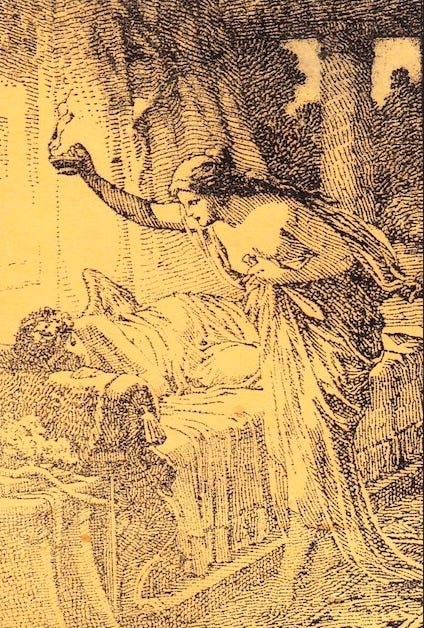
She rushed out after him into the night. She could not see him, but she heard his voice speaking to her. He told her who he was, and sadly bade her farewell. ‘Love cannot live where there is no trust,’ [Cupid] said, and flew away. ‘The God of Love!’ Psyche thought. ‘He was my husband, and I, wretch that I am, could not keep faith with him. Is he gone from me forever?’

“Nights in White Satin” The Moody Blues (1968, on Beat-Club; songwriter: Justin Hayward)