

Getting Curious About Incuriosity
Season 11, #1: Stargazing's first and last question—and why you should wonder about it

“He’d let us in,
Knows where we’ve been,
In his octopus’s garden,
In the shade…”
—The Beatles, “Octopus’s Garden”
A CONFESSION: I DEFINITELY struggled to write this.
It’s not like I had a bad plan—oh no. This StoryShed season (number 11, about Stargazing—more in a sec) is my treasure chest, the place where I generally feel the freest because it’s a topic near and dear to my heart: curiosity.
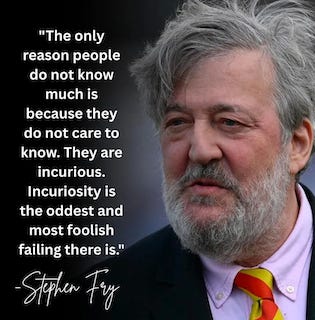
What kicked it off was the stray thought: Why are some folks allergic to curiosity? That is to say, why are some people curiosity-resistant?
What is the root cause of incuriosity?
You see, writing a blog about my life for nearly 10 years produced an interesting realization—I have three fairly distinct personality traits since I was at least seven years old. I now call these traits Daytalking, Nightwalking, and Stargazing.
Daytalking was a term that burbled up from somewhere in my head while I was writing a piece about Elton John’s “Your Song,” for my old WordPress blog.
Nightwalking followed in an essay about roaming my old lakeside neighborhood on summer nights and thinking about the Moody Blues’ “Nights in White Satin.” As the blog post relates, “…nightwalking was for dark, murky, wild longings, daytalking was about openly having it out, singing loud and proud, making it clear that ‘you can tell everybody, this is your song.’”
Stargazing’s original song was one of my earliest memories: Learning to sing “Twinkle, Twinkle, Little Star,” particularly the line “How I wonder what you are.”
A later blog post titled “Future Games” attempted to grasp the totality of Stargazing (at least for me). In it I wrote, “I used those early posts as sensory-based memory recall: I’d close my eyes and imagine what warm sunlight felt like on my young skin, nostrils filled with chlorine from the local pool, or [hearing] the jangle of a transistor radio playing nearby. It was intoxicating—it was pleasurable; I was a happy kid!”

So, Daytalking equals relationships, conversation, belonging, and “being-togetherness.” Nightwalking is lonelier and entirely solo, but with a heavy soundtrack and night shadows.
And Stargazing, where we’ve landed right now, is about curiosity, wonder, awe, the delight of discovery and the never-ending mysteries of—well, everything.
But back to the topic at hand—why do some people so completely lack curiosity?
And is it a larger problem for society?

THERE’S A SCENE IN J.D. Salinger’s short story “De Daumier-Smith’s Blue Period” where the main character and narrator, a 19-year-old we only know by the name of John Smith, has landed a job at a small art school in Montreal. I’m grateful to Clancy Steadwell for spurring me to re-read the story. Like most of Salinger’s stories, oddly enough, he seems to tap into any question I happen to be mulling over. It’s eerie.
Anyway, the buildup to that scene is how our lone artist in Montreal longs for a connection with his remote students—and he finds one in a correspondence with a nun named Sister Irma. He begins fantasizing about her:
…I thought, forcibly, of my star pupil. I tried to visualize the day I would visit her at her convent. I saw her coming to meet me—near a high, wire fence—a shy, beautiful girl of eighteen who had not taken her final vows and was still free to go out into the world with the Peter Abelard-type man of her choice. I saw us walking slowly, silently, toward a far, verdant part of the convent grounds, where suddenly, and without sin, I would put my arm around her waist. The image was too ecstatic to hold in place, and, finally, I let go, and fell asleep.
Well, a word of advice to the “forcibly thoughtful” M. De Daumier-Smith: Not only was the image “too ecstatic,” it was psychological poison.
Let me explain.
When I first noodled this episode of Season 11, I wanted to write about my ongoing curiosity with octopus intelligence. I wondered about how their “brain” is actually their entire being, from the central brain to the far reaches of their tentacles. I started with a statement (much like De Daumier-Smith’s cascading statements: “I would…I saw…”) and wrote down: “The octopus has 8 tentacles (or 6, or even 10).”
Then I turned that around and asked a question: “How many tentacles are on an octopus?”
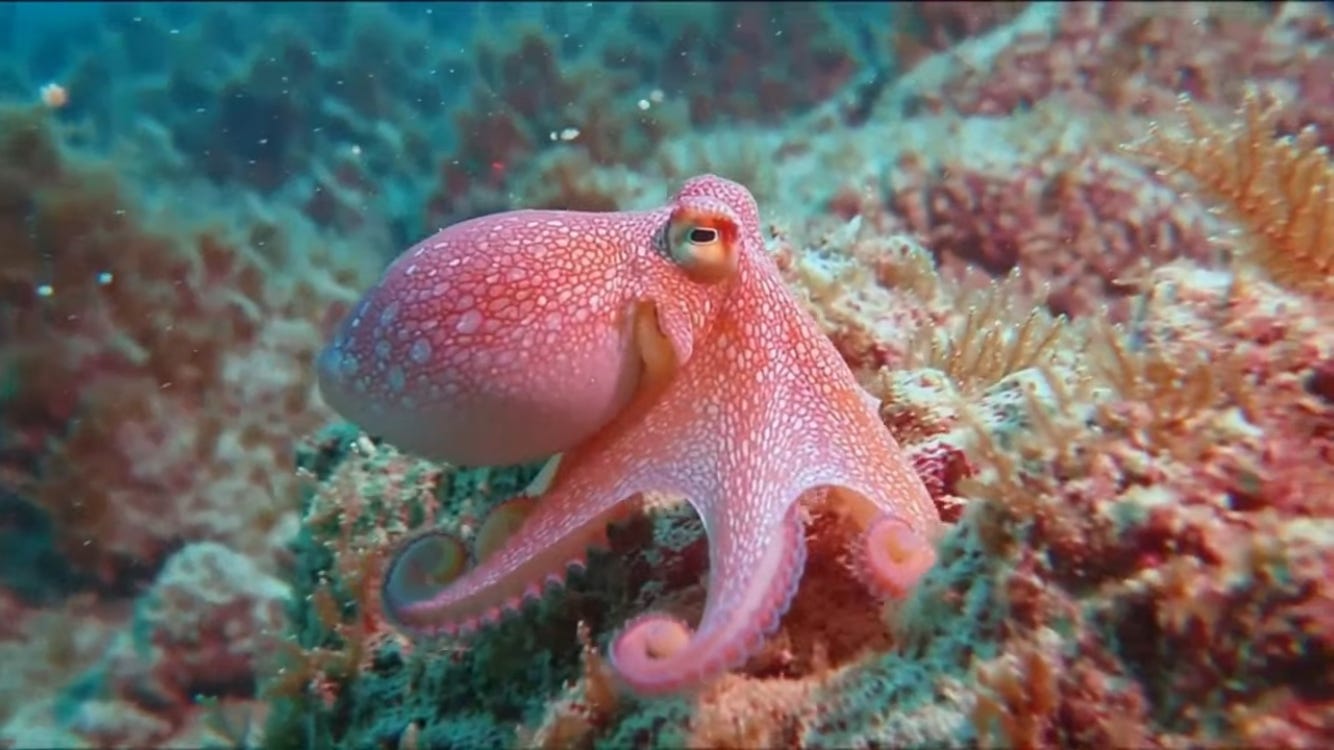
I was surprised to learn the answer: None.
Squid and cuttlefish have 8 arms and two tentacles. Octopuses (or octopi) have just 8 arms with suckers.
Then I quickly jotted down this term: “The tyranny of the imagination.” What, I wondered, is greater than that? “The supple strength of inquiry?”
From there I went deeper. Maybe the tyranny wasn’t the imagination, but a false statement or incorrect assumption (or even an outright lie). Turning that around, the greater approach might be using “the subtle power of inquiry.” Let’s get personal with that.
You might say: “You are angry at me.” I might respond with a yes or no and not say anything more (a closed response). If you turned that statement into a question, “Are you angry with me?” I still might give you a closed answer. We’re getting nowhere at this point. By asking an open question, “How are you feeling about me just now?” we’re exploring things more deeply and…
—Well, we’re cooking with gas.

You see, like Salinger’s “forcibly thoughtful” Mr. Smith, perhaps people make more assumptions and statements than they do asking questions. Don’t get me wrong—I can be as incurious and as presumptive as the next person. The thing is, when I get that way I nearly always (grumpily) wonder: “This isn’t right. Why am I feeling this way?”
So I did more exploring and discovered this study, which I found eye-opening [italics mine]:
“Brain-Imaging Study Reveals Curiosity as it Emerges”
“…the findings could have diagnostic and even therapeutic implications for those with depression, apathy or anhedonia (the inability to feel pleasure), which are conditions often marked by a lack of curiosity. …Curiosity entails a sort of enthusiasm, a willingness to expend energy and investigate your surroundings. And it’s intrinsically motivated, meaning that nobody is paying you to be curious; you are curious merely based on the hope that something good will come when you learn,” Dr. Gottlieb said. “Those are just some of the amazing things about curiosity.”
So, what initially began as a question for me, “Could I make an octopus friend this year and what would it feel like to be regarded (or doused with water) by an octopus?” and turned it into an exploration of why I love asking oddball questions in the first place.
Hey, I still have yet to make that new octopus friend. But the year is young. (And yes, I’ve seen the doc My Octopus Teacher and really enjoyed it.)
And I’m not sure how I can encourage more people to exercise their curiosity, except to say, “You might really enjoy it.”
Notes and extra texture
Learn about octopus superpowers…
Meet Ariel and Lucy, the Octopi! Friends tip: Always let them know they’re the boss.
Learn more about an octopus’s social life… 5:45 min in: “Octopuses that bump into each other either mate, eat each other—or both.” :-O
I love octopi in the wild, but just don't think wild creatures should be kept in cages by humans. I'm curious about your thoughts on it, Michael, now that you're fascinated by octopi.
To be curious you need to lift your head up from the trough. Most prefer to just Wall-E-it.
(And look at me, not being triggered by you bringing up those abominations again!)